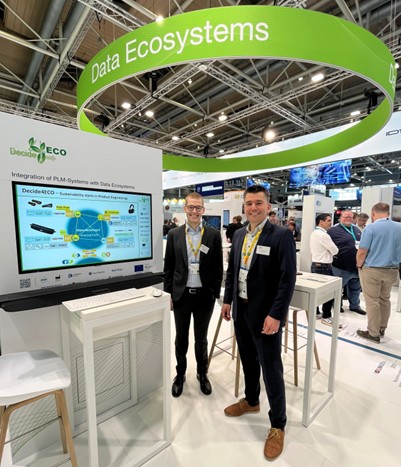
Under the motto "THINK TECH FORWARD", industry and science presented pioneering solutions for digital and sustainable industrial value creation at the Hannover Messe from 20-24 April 2026. At the joint stand of the Industry 4.0 platform, leading projects presented their solutions for so-called data ecosystems, systems in which companies share data and use this data to offer innovative products. One of the highlights presented was the "Decide4ECO" research project, which Paderborn University is realising with partners from industry.
The "Decide4ECO" project, funded by the German Federal Ministry for Economic Affairs and Energy (BMWE) with 7.3 million euros, is all about the acute need to take sustainability goals into account at an early stage of product development. The project is creating solutions that support companies in making forward-looking and sustainable decisions. If, for example, a car boot cover is powered by a motor, energy consumption can no longer be avoided later on, unlike with a manually operated cover. Or if the housing of headphones or a hearing aid is welded together, batteries can only be replaced later with great effort. A particular focus is on the data required for this. For comprehensive sustainability analyses, data from the entire supply chain must be brought together. Who supplies the motor and where is it installed? How much energy does it need? Can it be repaired if necessary? Who supplies the plastic granulate for the housing and at which location is it processed into a component?
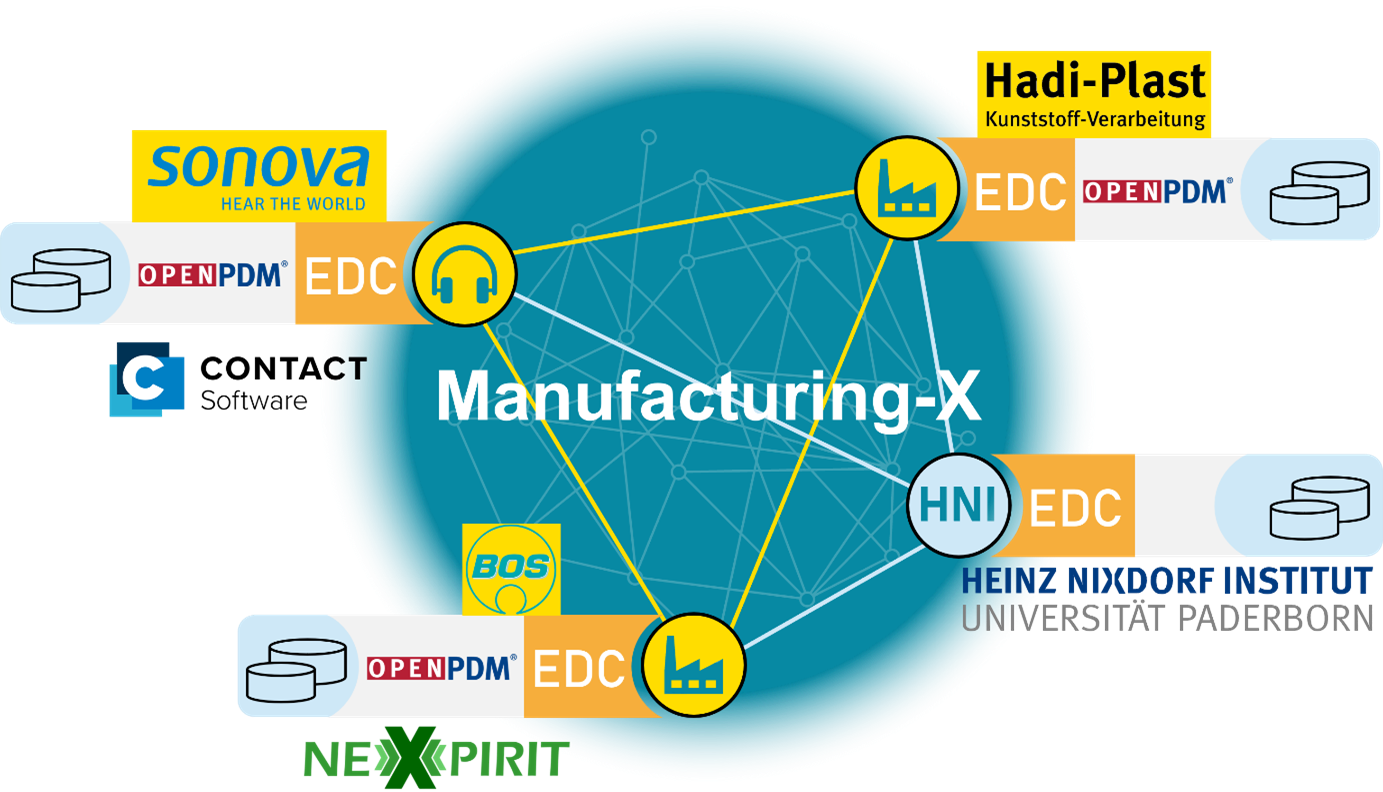
Decide4ECO provides one of the first examples of the great added value that the shared data ecosystem Manufacturing-X will deliver in the future. Information is provided in the form of digital product passports via open interfaces and standards and supplemented by values from sustainability databases. "In many cases, this is not completely new - but we combine technologies in such a way that proof of sustainability simply results from the data instead of having to collect it at great expense," says Professor Iris Gräßler from the Heinz Nixdorf Institute in Paderborn.
At the Hannover Messe, the partners in the Decide4ECO research project demonstrated the further development of their digital solutions. The focus was on connecting product lifecycle management systems, or "PLM" for short, to data ecosystems. Developers use digitally supported material evaluation to better understand and optimise the ecological balance of a product in the development phase. Dr Karsten Anger from the Hövelhof-based company Hadi-Plast emphasises: "CO2 footprint, reparability, proportion of recycled materials - such sustainability criteria can then already be taken into account in the procurement process." This makes it easier to select suppliers that meet both economic and environmental requirements, allowing companies like Hadi-Plast to stand out from the crowd. These extended functionalities are based on data from the entire value chain. Standardised interfaces enable traceability and interaction of sustainability data along the entire product life cycle.
Another added value of Decide4ECO is the targeted exchange of data across different systems. Functions such as the digital product passport, the calculation of sustainability and the evaluation of data quality have been integrated into the PLM tools. The technological development of the PLM systems is being driven forward by the IT partners CONTACT, PROSTEP and NEXPIRIT in collaboration with the "Product Creation" workgroup at the Heinz Nixdorf Institute at Paderborn University. New implementations for PLM systems such as CONTACT Elements and Siemens Teamcenter are being designed jointly. The solutions developed have been trialled in application-oriented case studies with industrial partners BOS, Hadi-Plast and Sennheiser.
The Paderborn team is helping to drive sustainable transformation forward - specifically in response to the practical challenges faced by companies. The focus is on developing innovative approaches to create flexible and sustainable value networks. This can be experienced at the institute: "In our laboratory, we demonstrate the combination of development and production data. Real machine data is recorded in the laboratory environment and then embedded in a digital product passport. This measured data is supplemented by emission values from sustainability databases and product data from PLM systems in order to increase the quality of the calculation results," says Sven Rarbach, a member of the scientific project team, describing the in-house demonstrator. The calculation is based on developed algorithms for flexible sustainability assessment. These key figures are made available to end users via a QR code on the component. In this way, the digital product passport can be experienced from creation to use.
Paderborn University is contributing Decide4ECO results to the national steering committee of Manufacturing-X and is also helping to shape the interface to Catena-X in the automotive industry. The solutions and methods developed in the project will continue to be trialled and continuously improved in industrial practice. Application partners use the innovative approaches to make their products more sustainable and participate in data ecosystems such as Manufacturing-X in the long term. In addition, the research results flow into teaching at the Heinz Nixdorf Institute - an example of how students ultimately also benefit from practice-orientated research in Mechanical Engineering.
More information about the project can be found here.