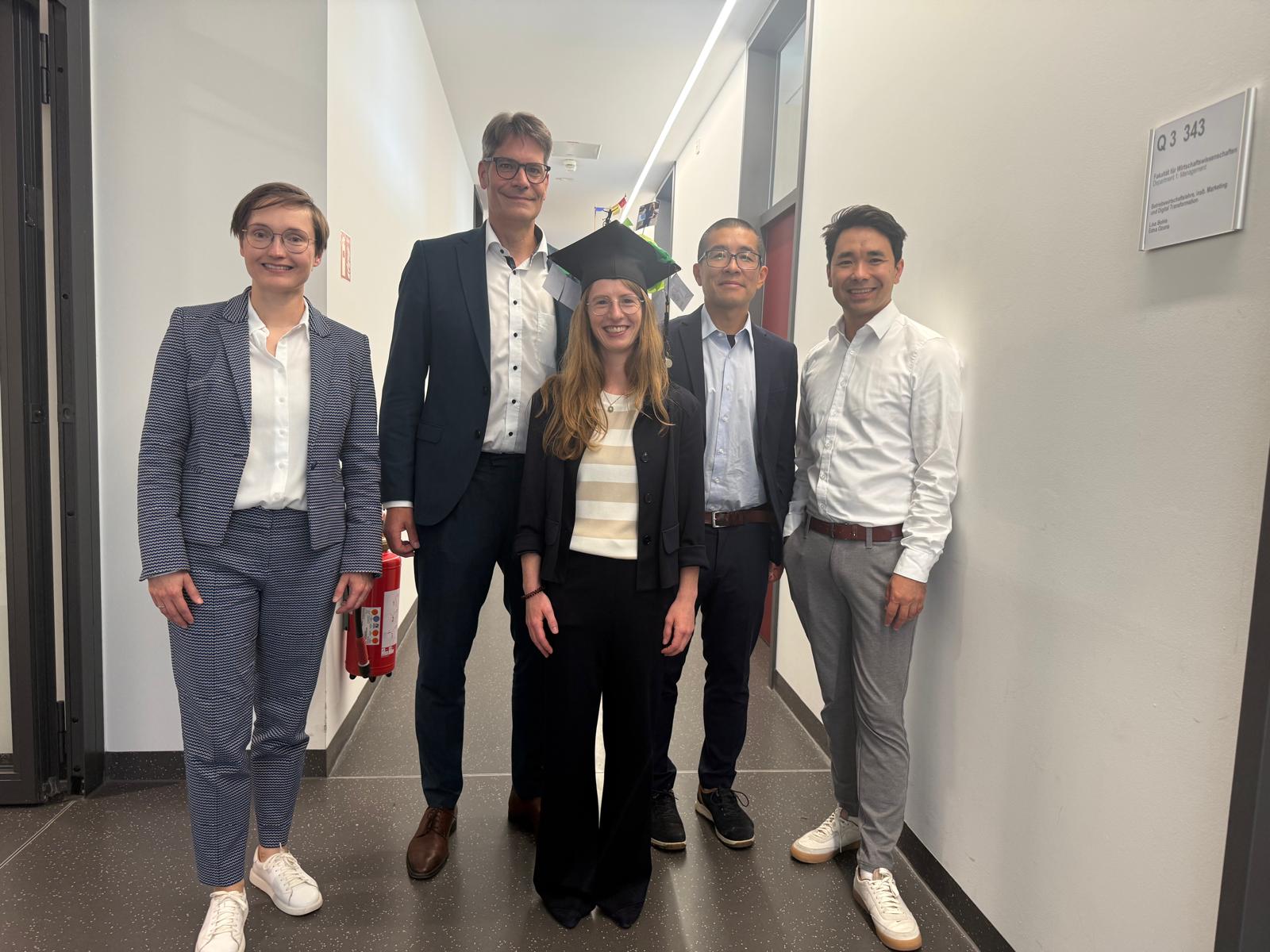
Sabrina Plaß successfully completed her doctorate on the topic of "Perspectives on Social Norms and Social Responsibility: Emerging Economic and Managerial Approaches" under Prof Dr René Fahr.
Summary of the doctoral dissertation:
Ecological crises, social unrest, and digital transformation have raised the need to rethink the economy. As such, digitalisation is transforming business operations and redefining their responsibilities towards society and the environment. Corporate self-commitment has been debated and practised for decades, yet its effectiveness depends on moving beyond polished mission statements and embedding sustainability into core business operations. Fuelled by external drivers - such as regulatory pressures, societal expectations, and technological advances - sustainability, once considered an add-on or ethical obligation, is increasingly becoming a strategic requirement for corporations. The pervasiveness of digital technologies requires managers to make decisions that balance economic, environmental, and social impacts of digitalisation, while leveraging digital technologies for genuine sustainability.
Amid the megatrends of sustainability and digitalisation, scandals like Facebook-Cambridge Analytica or Wirecard expose the dark side of corporate social irresponsibility. This emphasises a long-standing question: How should individuals behave when they observe corporate misconduct? CSR and whistleblowing are profoundly interrelated: While whistleblowing exposes corporate social irresponsibility, implementing whistleblowing mechanisms within credible CSR initiatives signals a genuine commitment to CSR practices and ensures that companies 'walk their talk'. However, successful organisational institutionalisation is only one side of the coin and does not guarantee whistleblowers will come forward. In this context, the influence of colleagues and social norms is increasingly apparent.
This doctoral dissertation critically examines the interplay between Corporate Sustainability (CS) and digitalisation, questioning how digital advancements align with sustainable corporate practices. It then introduces the emerging concept of Corporate Digital Responsibility (CDR), challenging its place alongside the more established Corporate Social Responsibility (CSR). Finally, it examines how coworkers influence the likelihood of potential whistleblowers coming forward. Building on these considerations, this doctoral dissertation employs behavioural economic experiments to explore the nuanced social expectations that influence whistleblowing on the micro level. These studies investigate how individuals (mis)perceive their peers' expectations: Do potential whistleblowers correctly estimate whether others believe it is appropriate to speak up? How do conflicting social expectations of two mutually exclusive actions - reporting and staying silent - as well as norm interventions affect decision-making? And how robust are the methods used to measure these normative expectations?
This doctoral dissertation maps the evolving landscape of CS and CSR in the digital age and outlines the mechanisms that shape individuals' whistleblowing decisions. The findings aim to contribute to a deeper understanding of how organisations can be sustainable and digitally progressive and how the social environment shapes our ethical decision-making.