What skills are needed in dismantling and subsequent reassembly to give products a new life?
Engineers shape the circular economy - because they have the expertise to develop products in such a way that all components can be reused as easily as possible. Does reuse then only mean that companies reuse individual components as unchanged as possible? In the DeCap project, this goal is significantly expanded to include capabilities for flexible disassembly and reassembly - with all the challenges involved in dealing with used, worn and dirty components. In other words, we understand "skills" to mean not only technical skills, such as new separation processes, but also human skills in particular, i.e. the competence and expertise of individual employees. The circular economy can only succeed if companies have these skills. But how can the dismantling of a product be incorporated years in advance, during product development? And how can it be ensured that products can also be dismantled with the technical skills of the machines and human skills of the fitters that are then available?
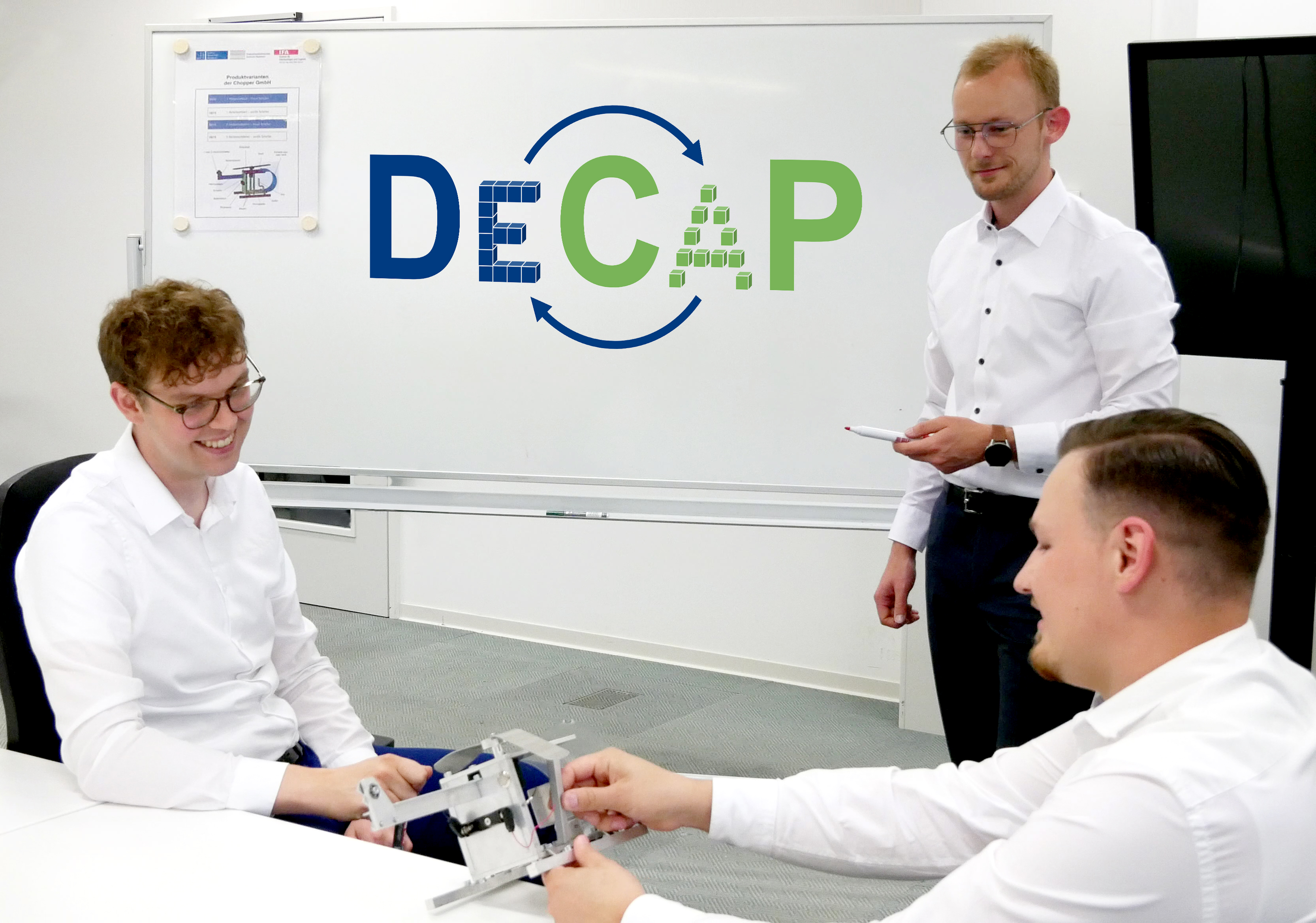
This is precisely where the approach of capability-orientated product development comes in, which the DFG project DesignforCapabilities (DeCap) is researching. Iris Gräßler at the Heinz Nixdorf Institute of Paderborn University is working together with the Institute of Production Systems and Logistics (IFA) at Leibniz Universität Hannover led by Prof. Dr.-Ing. Matthias Schmidt to support product development using artificial intelligence and the analysis of extreme data . In future, development decisions will be made in favour of later disassembly and reassembly. One challenge here is that although human skills can be observed during subsequent assembly, they are difficult to formalise. DeCap is researching solutions to this: Using a mix of data- and knowledge-based AI and data science methods, the required skills are derived from data from the production environment and product life and transferred into hybrid decision support.
Jens Pottebaum, Felix Vollenkemper, Thomas Hesse, Benedikt Grewe and Tim Meinecke have been working on solutions for managing and structuring extreme data since the project started in November 2024. Product, process and capability data are linked together in a metadata model. This model forms the basis for an ontology for utilising the data - and will be incorporated into solutions for decision support.
The project is part of the DFG Priority Programme 2443 "Hybrid Decision Support in Product Creation" (spp2443.de) coordinated by Prof. Dr. Iris Gräßler.