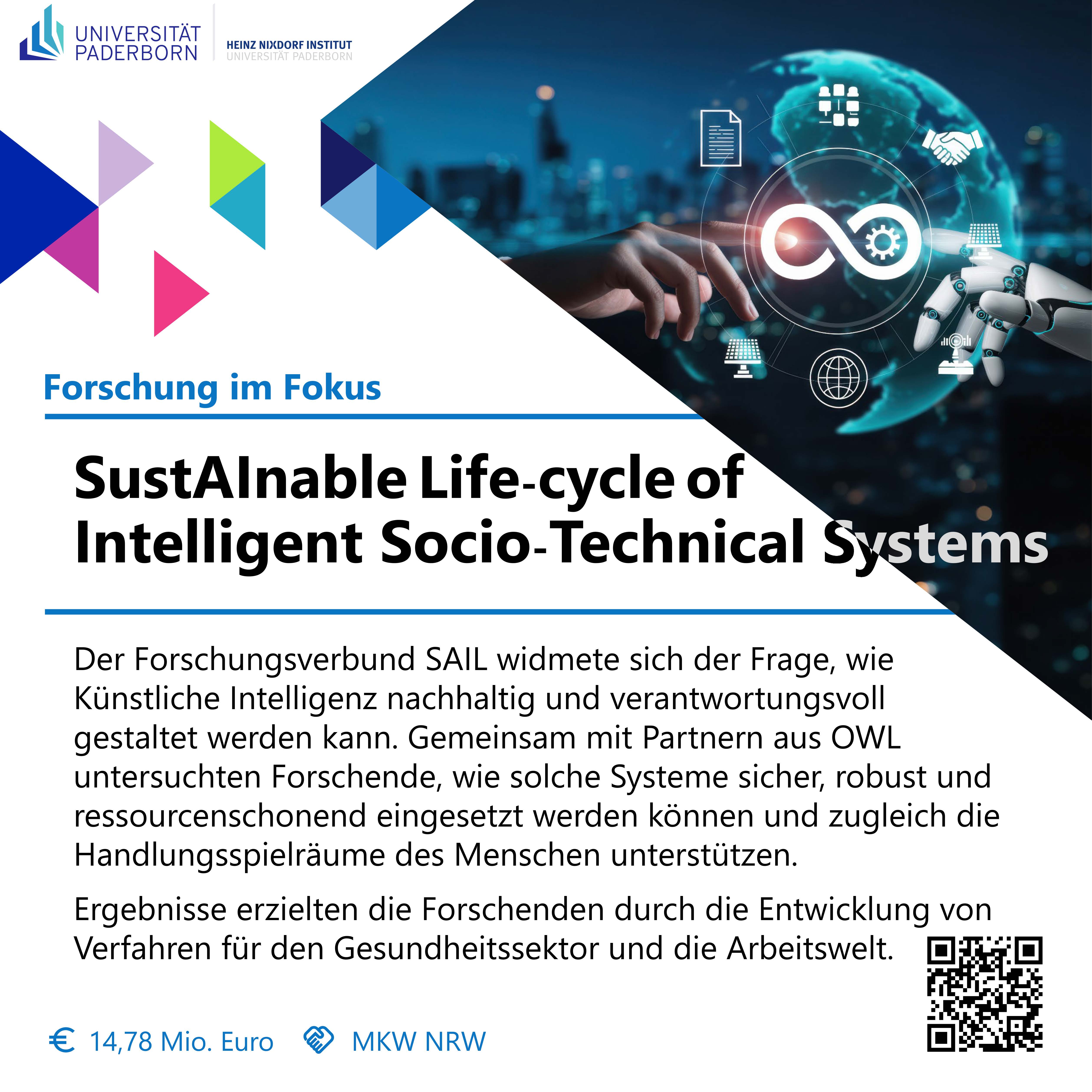
The SAIL research collaboration (“SustAInable Life-cycle of Intelligent Socio-Technical Systems”) focused on the question of how artificial intelligence (AI) can be designed in a sustainable and responsible manner. Together with partners from East Westphalia-Lippe, researchers from our institute investigated how such systems can be deployed safely, robustly and in a resource-efficient manner, whilst at the same time supporting people’s scope for action. The focus was therefore not only on high-performance technologies, but also on their integration into social and economic contexts.
From 2022 to 2026, around 80 researchers from Bielefeld University, Paderborn University, Bielefeld University of Applied Sciences and the Ostwestfalen-Lippe University of Applied Sciences worked together. The interdisciplinary research collaboration brought together perspectives from Computer Science, engineering, and the social sciences and humanities. SAIL was funded by the Ministry of Culture and Science of the State of North Rhine-Westphalia with 14.78 million euros.
The research ranged from the methodological and technical foundations of AI to specific issues in industry, health and care. Basic research focused, amongst other things, on making AI systems more robust, secure and transparent, examining large language and foundational models throughout their entire life cycle, and making their development and use more efficient and resource-friendly. Further work focused on the processing and interlinking of knowledge, as well as on methods for the transparent evaluation of AI systems.
In parallel, application-oriented projects investigated how AI can provide meaningful support to people in various areas of life and work. For example, researchers developed methods for detecting mislabelled blood samples, which are intended to contribute to improved patient safety. Other projects focused on AI-based assistance systems for the workplace, which take into account not only productivity but also well-being, the meaningfulness of work and self-determination. In the healthcare sector, research was also conducted into the conditions under which people trust AI-supported healthcare applications and how machine learning can be used in a smart care bed for sensor-based patient monitoring.
To date, the research collaboration has produced more than 270 scientific publications. Retreats, the ‘Robust AI’ lecture series and numerous presentations at international conferences have also fostered scientific exchange. Spring schools, workshops and colloquia supported postgraduate training, whilst hackathons, hands-on events and science slams made research accessible to the interested public. The collaboration will continue even after the project ends: the participating universities are now part of the ELLIS Unit NRW, thereby strengthening East Westphalia-Lippe in the long term as a centre for AI research with a social mission.
Scan the QR code to find out more about the “SAIL” research project!